Selecting Secure Encrypted Storage-A Practical Guide to Hardware Encryption and Brute-Force Defense
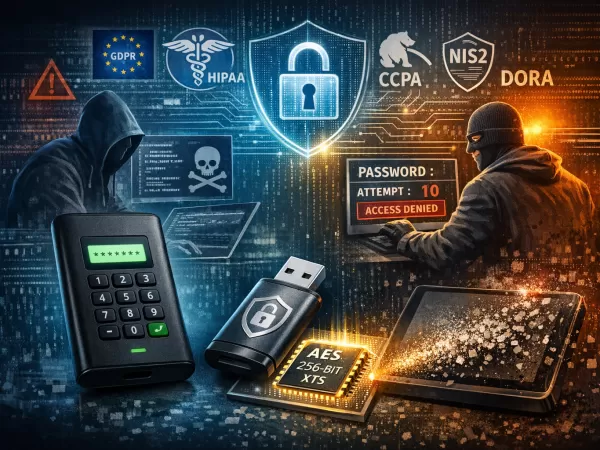
Protecting personal privacy and confidential business data is a foundational requirement of modern information security. As data sensitivity levels vary widely and encrypted storage products differ significantly in implementation quality, selecting the right solution can be challenging.
Beyond considerations such as usability, physical form factor, and performance, encrypted storage devices must also meet increasingly strict regulatory and compliance requirements, including HIPAA, GDPR, CCPA, NIS2, and DORA.
While organizations often invest heavily in network perimeter security, mobile storage media—such as USB flash drives and external SSDs—are frequently overlooked. This blind spot poses a serious risk: improper selection of portable storage devices can directly lead to data breaches, regulatory violations, and substantial legal liability.
In today’s environment of escalating cyber threats, hardware-encrypted storage devices are widely recognized as the preferred solution for protecting high-value data. However, not all “encrypted” products deliver the same level of security. The following sections outline the critical factors enterprises should evaluate when selecting high-security storage devices.
1. Core Security Architecture: Hardware Encryption and Algorithm Standards
The method by which encryption is implemented is the single most important determinant of a storage device’s security level.
Hardware Encryption vs. Software Encryption
Software-based encryption depends on the host operating system and CPU to perform cryptographic operations. As a result, encryption keys may be exposed in system memory and are potentially vulnerable to malware, debugging tools, or brute-force attacks.
In contrast, hardware-encrypted storage devices perform all cryptographic operations within a dedicated secure microcontroller. Encryption keys are generated and stored in a physically isolated secure element and never leave the device. This architecture effectively eliminates key exposure risks and provides a significantly higher level of protection.
Encryption Algorithm Standards
AES 256-bit encryption in XTS mode is the current industry benchmark for data-at-rest protection. This algorithm provides extremely high cryptographic strength and is designed to resist modern cryptanalysis techniques.
Enterprise-grade security drives should implement always-on, hardware-based XTS-AES 256-bit encryption at the firmware level, ensuring that all data is protected by default without reliance on user behavior.
2. Active Defense Mechanisms: Brute-Force Protection and Crypto-Erase
Encryption alone is insufficient without active defenses against password-guessing attacks.
High-security storage devices should enforce strict limits on authentication attempts. Once a predefined threshold of consecutive incorrect passwords is reached, the device automatically initiates a Crypto-Erase process, permanently destroying the encryption keys and rendering all stored data irrecoverable.
This self-destruct mechanism serves as the final safeguard in scenarios involving device loss or theft, ensuring that sensitive data cannot be accessed even through prolonged brute-force attempts.
3. Mandatory Encryption Design: Always-On Protection
To eliminate risks introduced by human error, encryption must be non-optional.
Some consumer-grade encrypted drives allow users to disable encryption, creating a serious compliance vulnerability in enterprise environments. For regulated industries, encryption must be permanently enabled and enforced at the hardware level.
Always-on encryption ensures that all data at rest remains protected at all times, regardless of user configuration, making the device inherently compliant with data protection regulations.
4. Independent Verification: FIPS Certification
The Federal Information Processing Standards (FIPS), established by the U.S. National Institute of Standards and Technology (NIST), are globally recognized benchmarks for cryptographic security.
FIPS 197 validates the correct implementation of the AES encryption algorithm.
FIPS 140-3 Level 3 represents a higher assurance level, requiring not only cryptographic correctness but also physical tamper resistance, identity-based authentication, and robust key management.
Security drives certified by NIST-accredited laboratories provide independently verified assurance that the product meets government- and enterprise-grade security requirements.
5. Advanced Threat Mitigation and Functional Enhancements
Beyond baseline encryption, advanced protection against emerging attack vectors is increasingly critical.
BadUSB Protection
BadUSB attacks compromise USB device firmware, allowing a storage device to impersonate trusted peripherals such as keyboards and inject malicious commands into the host system.
Drives equipped with digitally signed firmware (e.g., RSA 2048-bit) verify firmware integrity during every boot cycle. If unauthorized modification is detected, the device automatically locks, preventing malicious behavior at the hardware level.
OS-Independent Authentication
Some high-security drives integrate physical keypads or touchscreens, enabling user authentication before the device is connected to a host system. This design removes dependency on host-side software or drivers, ensures cross-platform compatibility, and protects credentials from keyloggers and malware.
Balancing Security and Usability
Support for complex password policies, long passphrases, and multi-user management (separate Admin and User roles) allows organizations to maintain strong security controls while improving deployment and administrative efficiency.
6. Business Continuity and Air-Gapped Backups
Ransomware continues to pose a major threat to enterprises of all sizes. The widely adopted 3-2-1 backup strategy—three copies of data, on two different media types, with one copy stored offline—remains a best practice.
High-capacity, hardware-encrypted storage devices are ideal for air-gapped backups, where backup media remains physically disconnected from networks. This approach ensures that critical data cannot be encrypted or compromised by ransomware, enabling rapid recovery in the event of an incident.
Conclusion
Selecting the right encrypted storage device is a critical component of a defense-in-depth security strategy. Enterprises should prioritize vendors with proven expertise in data security, robust firmware design, and validation through independent certification and penetration testing.
Consumer-grade software encryption solutions introduce unnecessary risk. Professional-grade security drives featuring XTS-AES 256-bit hardware encryption, brute-force protection, mandatory always-on encryption, FIPS certification, and BadUSB defense provide the level of assurance required to protect sensitive data and meet increasingly stringent regulatory obligations.
Investing in secure storage is not only a technical decision—it is a fundamental responsibility toward data protection, compliance, and long-term business resilience.